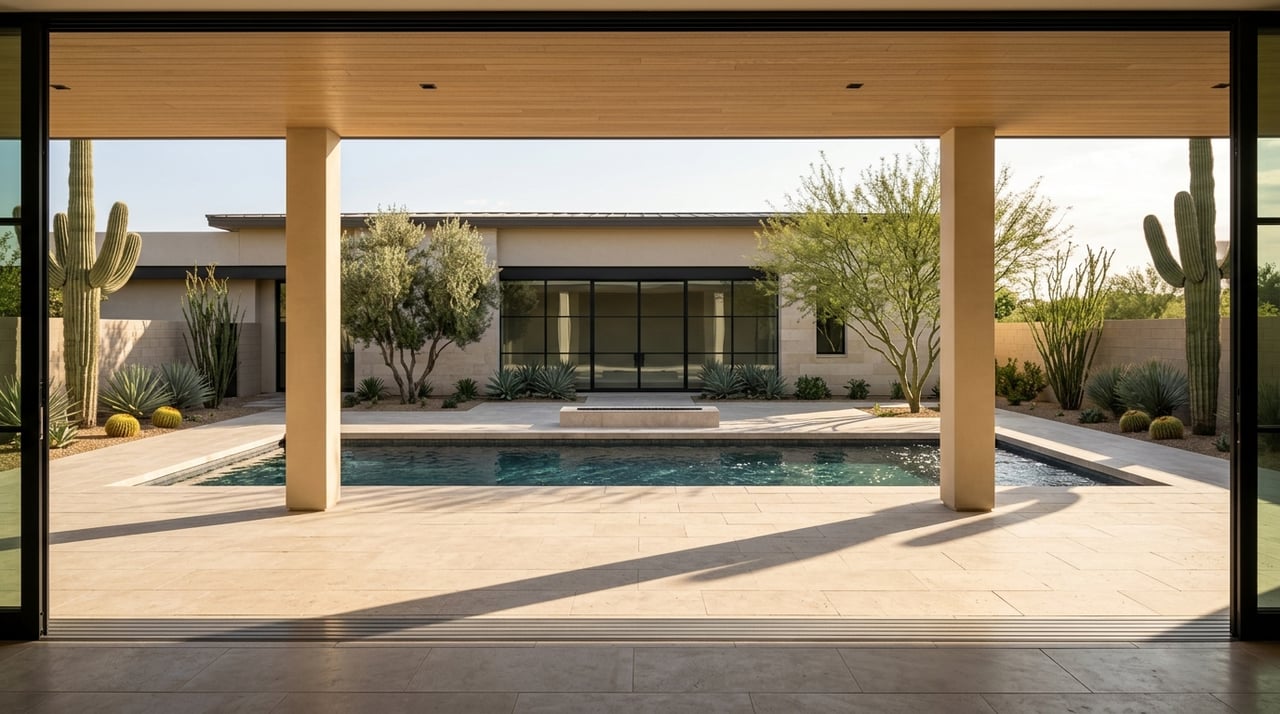
Wondering whether Paradise Valley or Scottsdale is the better fit for your next luxury home? It is a smart question, because while these two markets sit side by side, they offer very different living environments. If you are weighing privacy, lot size, resort access, walkable activity, or travel convenience, this guide will help you compare the lifestyle tradeoffs with more clarity. Let’s dive in.
Paradise Valley vs Scottsdale at a glance
Paradise Valley and Scottsdale are neighbors, but they operate at very different scales. According to Census QuickFacts, Paradise Valley has 12,251 residents across 15.38 square miles, while Scottsdale has 246,170 residents across 184.00 square miles.
That difference shows up in how each place feels day to day. Paradise Valley was organized to preserve a one-house-per-acre minimum and remain entirely residential. Scottsdale, by contrast, includes an urban center in Old Town with more than 90 restaurants, 320 retail shops, and more than 80 art galleries.
Lot sizes and zoning feel different
For many luxury buyers, the first real difference is land. Paradise Valley is generally the more restrictive estate market, and that matters if you want space, privacy, and a more consistent residential setting.
The town’s resident guide says most of Paradise Valley is zoned R-43, which requires at least one acre per lot. Other zoning districts include R-175 at 4 acres, R-35 at 35,000 square feet, R-18 at 18,000 square feet, and R-10 at 10,000 square feet. The guide also notes that nonresidential uses need special-use permits and that hillside work can require town approval.
Scottsdale offers a much broader range of property types. The city’s General Plan includes higher-density residential areas, mixed-use neighborhoods, apartments, high-density townhouses, business centers, and resorts. That means your options can range from a more urban home near Old Town to a larger custom property in a lower-density pocket.
Paradise Valley is built for estate living
If your ideal home sits on a large parcel with a more controlled surrounding environment, Paradise Valley often aligns well with that goal. Its planning framework supports a quieter, more uniform residential pattern.
That does not mean every home is the same. It means the town’s rules tend to reinforce larger lots, lower intensity, and stronger design oversight than you will usually find in a broader city setting.
Scottsdale offers more housing variety
Scottsdale’s flexibility is part of its appeal. In one part of the city, you can find urban energy, contemporary condos, or homes near retail and dining. In another, you can find lower-density luxury pockets with very different lot sizes and streetscapes.
A strong example is the Cactus Corridor area, where the city describes low-density lots ranging from 35,000 square feet to 2.5 acres, along with large front setbacks. This is a good reminder that Scottsdale is not just one thing. It is a collection of submarkets with different lifestyles and home styles.
Home styles and neighborhood character
Architecture and setting can shape your buying decision just as much as square footage. Paradise Valley often appeals to buyers who want custom estates and a more cohesive luxury setting.
Scottsdale gives you more variation by design. Official city materials reflect everything from postwar neighborhoods and ranch homes to contemporary homes, mixed-use areas, and resort districts.
Choose Paradise Valley for consistency
Paradise Valley tends to reward buyers who want a tighter luxury enclave. The overall environment leans residential, lower density, and more curated in feel.
If you value design control and a stronger sense of separation from commercial activity, that can be a meaningful advantage. Many buyers see that as part of the town’s long-term appeal.
Choose Scottsdale for options
Scottsdale works well if you want more choice in architecture, neighborhood format, and day-to-day rhythm. You can prioritize a quieter pocket, an urban setting, a resort-oriented area, or something in between.
That variety is one of Scottsdale’s biggest strengths. It allows you to match the property not just to your budget, but to how you actually want to live.
Lifestyle and amenities set the tone
Lifestyle is where the contrast becomes especially clear. Paradise Valley is officially described as a quiet desert oasis surrounded by Camelback Mountain, the Phoenix Mountain Preserve, and the McDowell Mountains.
The town’s resort listings include Camelback Inn, Hermosa Inn, Kimpton Miralina, Mountain Shadows, Omni Scottsdale Resort & Spa at Montelucia, Sanctuary Camelback Mountain, and the planned Ritz-Carlton Paradise Valley. That creates a strong resort-adjacent identity with mountain views and a quieter pace.
Scottsdale has a broader amenity base. The city highlights Old Town’s more than 90 restaurants, 320 retail shops, and more than 80 art galleries, along with the McDowell Sonoran Preserve, which it describes as roughly 35,000 acres of preserved Sonoran Desert.
Paradise Valley suits resort-minded buyers
If you picture luxury living as privacy, mountain backdrops, and proximity to destination resorts, Paradise Valley often fits naturally. The environment feels more secluded and less activity-driven.
For second-home buyers and relocators, that can be a major draw. You get a residential setting with easy access to high-end hospitality and desert scenery.
Scottsdale suits active daily living
If you want more built-in options for dining, shopping, arts, and outdoor access, Scottsdale often has the edge. Its amenity density is simply broader.
This can be especially attractive if you want variety close at hand. Rather than one lifestyle lane, Scottsdale gives you several.
Commutes, mobility, and airport access
Transportation can matter more than buyers expect, especially if you travel often or split time between cities. Paradise Valley’s 2022 General Plan says the automobile is the primary transportation mode between the town and the rest of the Valley because regional transit and non-vehicular service is limited.
The plan identifies limited Valley Metro service on Scottsdale Road, Shea Boulevard, and Tatum Boulevard, along with two local routes. It also notes that resorts offer shuttles and other transportation options to Phoenix, Scottsdale, and Phoenix Sky Harbor International Airport.
Scottsdale provides more local mobility choices. The city says residents can use the free trolley system in Old Town, Valley Metro bus routes, paratransit services, and a bike network supported by the city over many years.
Scottsdale may help frequent flyers
Scottsdale also has its own airport. The city describes Scottsdale Airport as an ideal option for leisure and business travelers, while the airport’s noise page explains that it is a general-aviation reliever facility with no scheduled commercial service.
If private aviation access matters to you, that can be a practical advantage. It is one of the clearest lifestyle distinctions between the two locations.
Paradise Valley favors a quieter road environment
Paradise Valley’s General Plan ties traffic management to preserving the town’s scenic and quiet semi-rural character. That tells you a lot about the town’s priorities.
Commute times are fairly close on paper, with Census QuickFacts listing mean travel times to work of 20.7 minutes in Paradise Valley and 21.6 minutes in Scottsdale. In real life, the bigger difference is often the roadway setting and transportation style you want around you every day.
Pricing context for luxury buyers
Luxury buyers also look at market positioning. Paradise Valley’s resident guide reports citywide owner-occupied home values of $2,000,000+ versus $789,800 in Scottsdale.
That does not mean Scottsdale is not a luxury market. It clearly is. It means Paradise Valley tends to sit in a tighter, higher-value estate lane, while Scottsdale covers a wider luxury spectrum with more submarkets and more price diversity.
How to decide between Paradise Valley and Scottsdale
The best choice depends less on which place is better and more on which environment matches your priorities. When you narrow the decision through that lens, the answer usually gets clearer.
Choose Paradise Valley if you want:
- Larger parcels
- A more uniformly residential setting
- Stronger design oversight
- Resort-adjacent living
- A quieter, lower-density feel
Choose Scottsdale if you want:
- More neighborhood variety
- Easier access to dining and retail
- Old Town energy and arts access
- Broader housing styles and parcel sizes
- More local transportation options
One final buyer tip
Do not rely on the city name alone. Scottsdale includes low-density luxury pockets, and Paradise Valley can still vary by street, lot, and surrounding context.
For that reason, your best next step is to compare specific areas, block by block, based on how you live, travel, and use your home. In a market this nuanced, local guidance can make the decision much easier.
If you are deciding between Paradise Valley and Scottsdale, the right strategy starts with clarity around your lifestyle, property goals, and access to the best opportunities on and off market. The team at RETSY can help you compare both markets with a polished, data-informed approach tailored to your next move.
FAQs
What is the main lifestyle difference between Paradise Valley and Scottsdale for luxury buyers?
- Paradise Valley is generally more private, lower density, and resort-adjacent, while Scottsdale offers more day-to-day variety in dining, retail, arts, and neighborhood types.
Are lot sizes usually bigger in Paradise Valley than Scottsdale?
- Often yes, because much of Paradise Valley is zoned for large lots, including one-acre minimums in many areas, though Scottsdale also has low-density luxury pockets such as Cactus Corridor.
Is Scottsdale still a luxury market if it feels more active?
- Yes. Scottsdale includes luxury properties in urban, resort, and lower-density settings, but it offers a wider range of environments than Paradise Valley.
Which area is better for private air travel in Greater Phoenix?
- Scottsdale has a direct private-aviation asset through Scottsdale Airport, while Paradise Valley relies more on automobile access, resort transportation options, and connections to Phoenix Sky Harbor.
Is Paradise Valley more residential than Scottsdale?
- Yes. Paradise Valley’s history and land-use approach emphasize an entirely residential environment with limited nonresidential uses requiring special approval.
How should you choose between Paradise Valley and Scottsdale when buying a luxury home?
- Start with your priorities around privacy, parcel size, design controls, daily activity level, and travel needs, then compare specific neighborhoods and streets that match those goals.